Most indoor cats have more hunting instinct than their day gives them a chance to use. The right interactive toys fill that gap: something to stalk, chase, pounce on and catch. The wrong ones end up under the sofa after a day, or become a safety risk when nobody’s watching. This guide to interactive cat toys for indoor cats explains the six main types, which cats each one suits, how to build a short daily play routine and what you can safely leave out when you’re not home.
Why indoor cats need interactive play
Even a well-fed indoor cat is still a hunter. The sequence of watching, stalking, chasing, pouncing and catching is part of how cats are wired. Without an outlet, that energy often turns into night-time zoomies, ambushes on your ankles or a cat who simply sleeps all day.
Veterinarians include this in the AAFP/ISFM Feline Environmental Needs Guidelines, which list opportunities for play and predatory behavior as one of the five pillars of a healthy indoor environment. PetMD suggests two or three play sessions of 10 to 15 minutes a day, depending on your cat’s age and energy, and notes that a few short sessions work better than one long one.
Interactive toys make those sessions easier to keep up, and some of them keep your cat busy between sessions while you’re at home.
The 6 main types of interactive cat toys
| Type | Best for | Do you need to be there? |
|---|---|---|
| Wand toys | Every cat; the most complete hunting game | Yes, or at least close by |
| Toys that move on their own | Chasers and young, active cats | Supervised play |
| Touch-activated toys | Cats who stalk and wrestle | Supervised play |
| Ball track towers | Kittens and cats who like to bat | Supervised play (small parts) |
| Puzzle toys | Clever, food-motivated or easily bored cats | Supervised play (small ball) |
| Tunnels and hideouts | Ambushers, shy cats, multi-cat homes | Fine to leave out, with any dangling toy removed |
1. Wand toys
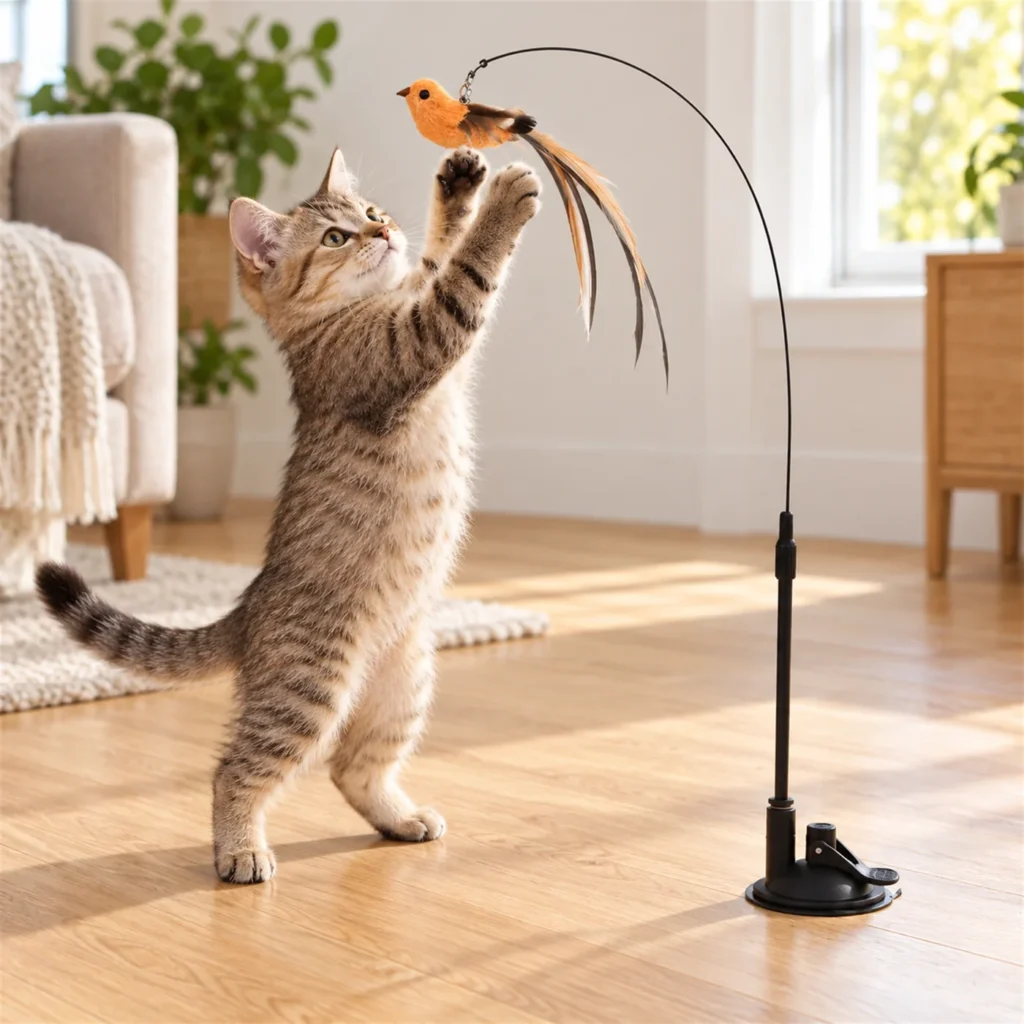
A wand toy is the closest thing to real prey, because you control it. You can make it hide, freeze, flutter and run, then let your cat catch it. For most cats, this is the single best play session of the day.
Our bird wand with a suction cup base works two ways: pull the rod out for a hands-on session, or press the base onto a smooth floor, window or tile so the feathered bird keeps bouncing after every swipe while you’re nearby. Wand toys with long strings or feathers should be used with supervision and put away afterward, as Best Friends Animal Society also advises.
2. Toys that move on their own
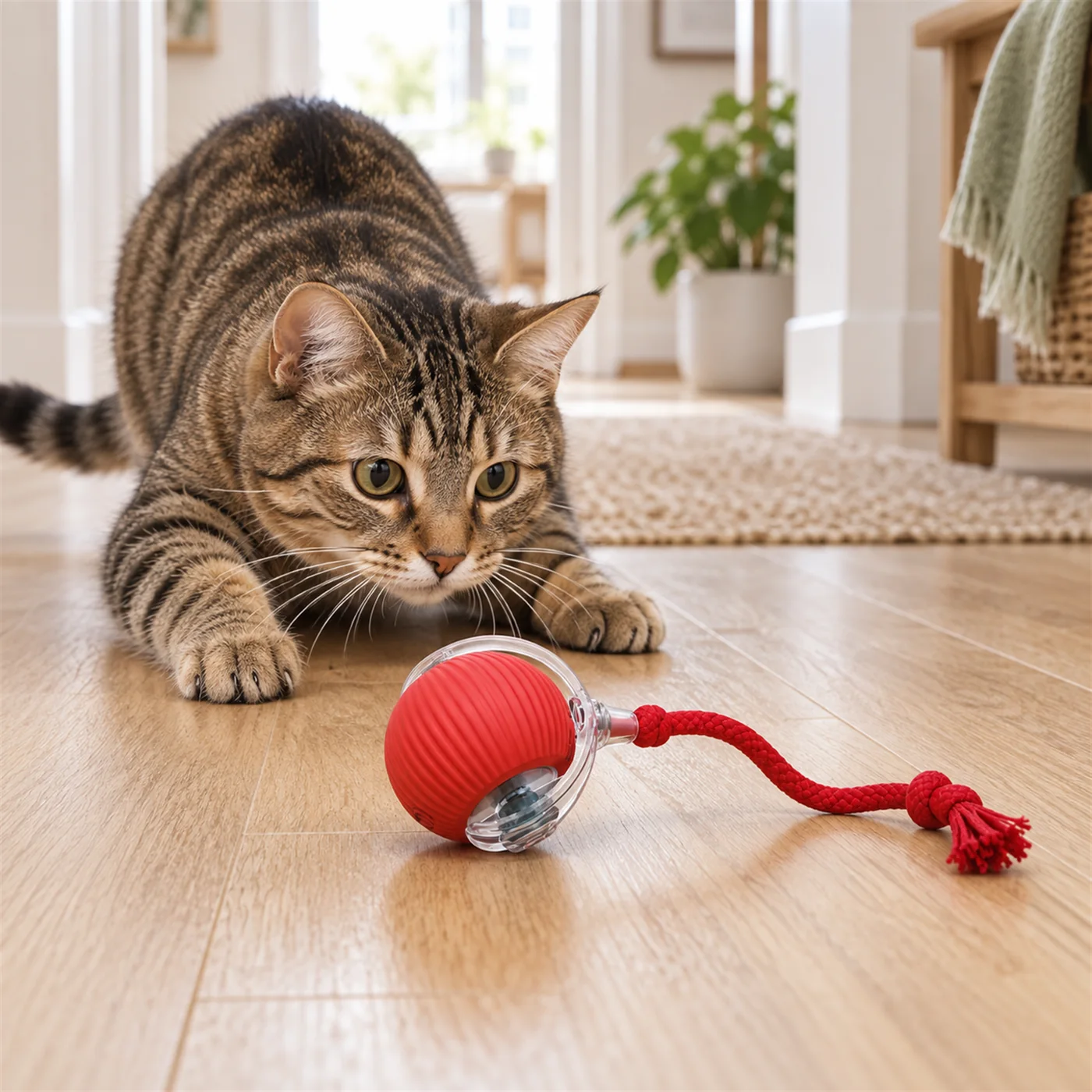
Some cats only get excited by something that runs away. Motorized toys do exactly that, and they’re useful when you’re home but busy, for example working from a laptop in the same room.
- An automatic rolling ball rolls off in random directions, turns when it bumps into furniture and drags a tail behind it. It works best on hard floors and low rugs.
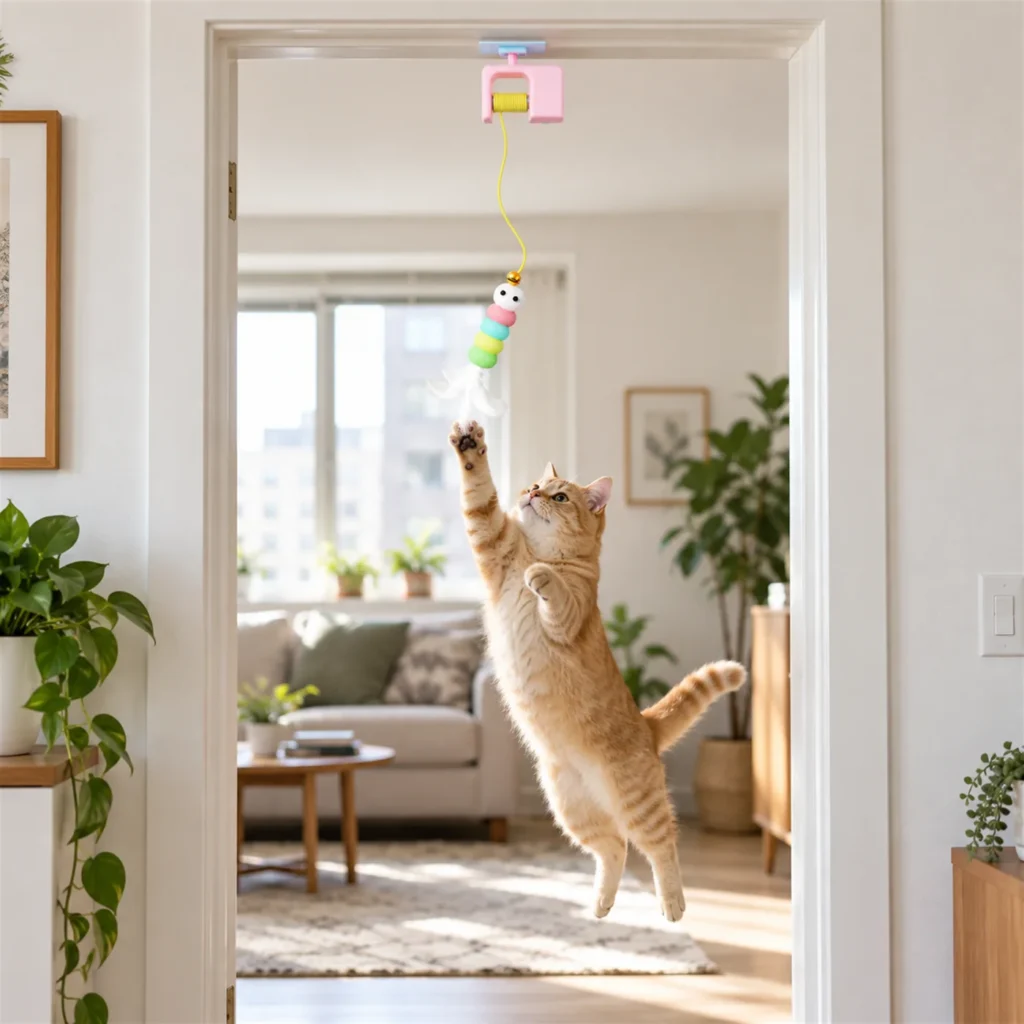
- A door-hanging electric teaser sticks above a door frame or a cabinet and lifts and drops two toys on elastic cords, so your cat has something to jump for.
Both are rechargeable, and both come with ropes or tails. Unhook or switch them off and put them away when play is over.
3. Touch-activated toys
Touch-activated toys stay still until your cat pats them, then react. That suits cats who like to stalk slowly and then wrestle their prey.
Our chirping flapping bird is a plush sparrow that flaps its wings and plays bird sounds when your cat touches it, then goes quiet until the next pounce. It doesn’t fly: it stays on the floor, and it has a refillable catnip pocket for cats who need a little extra motivation.
4. Ball track towers
A ball track tower has balls that spin around stacked rings but can’t be knocked out, so a cat can bat them round and round. Kittens in particular love them, and they’re compact enough for a small apartment.
Our ball track tower is about 7.1 in wide and 6.3 in tall, with a feather on a spring that plugs into the top for cats who like to swipe upward. Like any toy with small parts, it’s best used while you’re around.
5. Puzzle toys
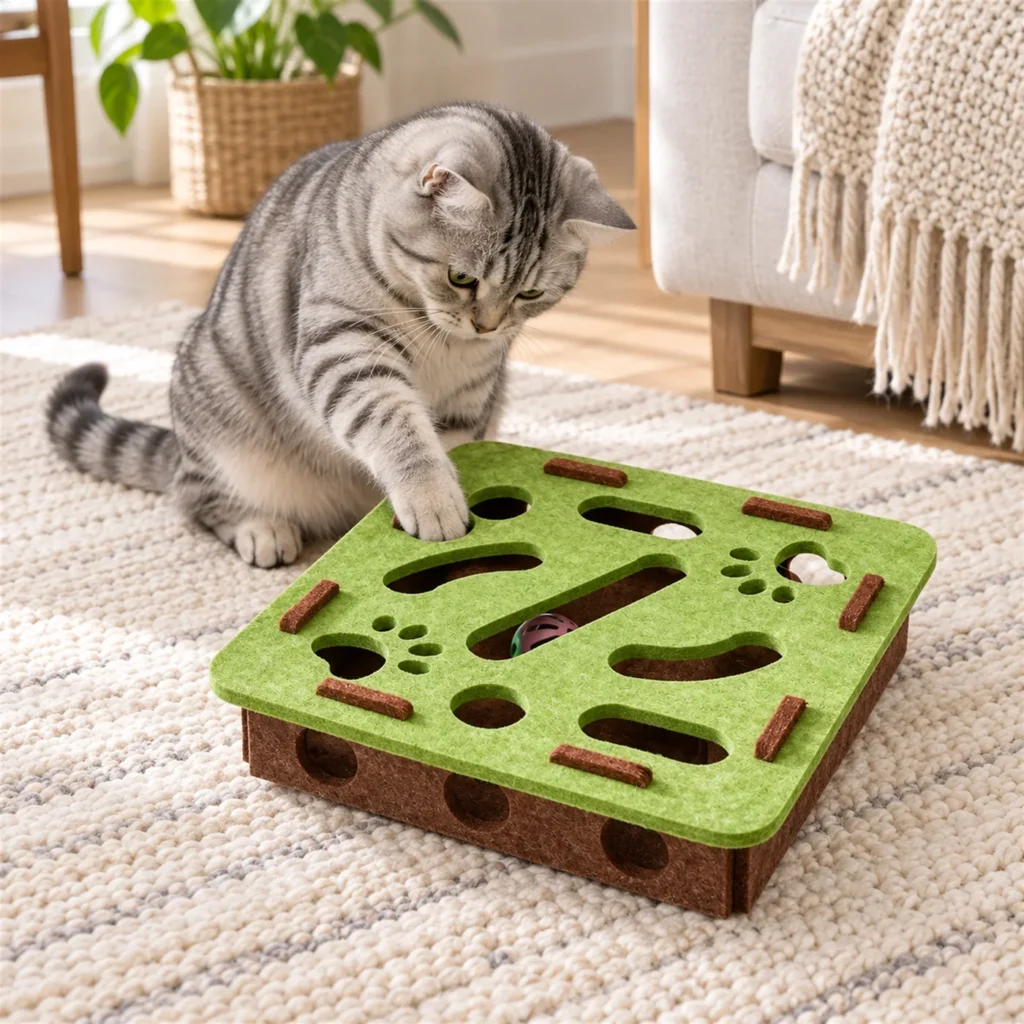
Puzzle toys turn play into a small problem to solve. Food puzzles hide kibble or treats that your cat has to work out, which also slows down fast eaters. Other puzzles hide a ball instead of food.
Our felt puzzle box has paw-sized openings and a bell ball inside: your cat reaches in, fishes the ball out and chases it through the channels. The felt top doubles as a light scratching surface.
6. Tunnels and hideouts
Tunnels aren’t toys in the usual sense, but they’re one of the most used pieces of play equipment for many cats: somewhere to hide, ambush from and race through. They also give shy cats a place to watch without being seen.
A collapsible tunnel folds flat when you need the floor back, and a felt tunnel bed is a bed on top and a hideaway inside, which saves space in a small apartment.
How to choose the right toy for your cat
- Watch how your cat hunts. Some cats stalk along the floor, some leap at things above them and some prefer to fish things out of gaps. Pick toys that match: a rolling ball for floor chasers, a door-hanging teaser or a wand for jumpers, a puzzle box for fishers.
- Consider age and energy. Kittens and high-energy breeds, such as Bengals and Abyssinians, usually need more play than calmer breeds like Persians and Ragdolls, according to PetMD. Older cats still enjoy play, but at a gentler pace: slower wand movements and toys on the floor rather than high jumps.
- Think about your floor. Rolling toys work best on hard floors and low rugs. On thick carpet, choose a teaser, a wand or a puzzle.
- Mix hands-on and solo play. A wand toy for the main session, plus one or two toys that keep your cat busy while you’re nearby, covers most of the day.
A simple 15-minute play routine
You don’t need a complicated schedule. Many cats do well with a routine like this, once or twice a day:
- Warm up (2 to 3 minutes). Move a wand toy slowly along the floor and behind furniture, the way a mouse would. Let your cat watch and stalk.
- Chase (5 to 8 minutes). Speed up, change direction, let the toy hide and reappear. For a jumper, lift it into short arcs.
- Catch. Let your cat catch the toy several times, and always end on a real catch. If you use a laser pointer, finish with a toy your cat can actually grab, so they don’t end up frustrated.
- Wind down, then food. Slow the toy down, let your cat “win” one last time, then serve a meal or a few treats.
Play before you leave in the morning and again in the evening. An evening session followed by dinner often helps with night-time zoomies: see how to tire out a cat before bed. For more ideas, read signs your cat is bored (and 12 easy fixes).
Can you leave interactive toys out when you’re not home?
This is where many “toys for when you’re away” lists skip the safety part.
Toys with strings, ropes, cords, ribbons or feathers should be put away when you go out. Cats can swallow string, yarn and similar material. VCA Animal Hospitals describes these long, thin objects as “linear foreign bodies”, which can cause a serious intestinal blockage. Signs include vomiting, not eating, lethargy and hiding more than usual. If you think your cat has swallowed string, call your vet straight away.
Motorized toys are best used while you’re home. A toy that keeps running, gets stuck under furniture or is chewed while you’re out is a risk, which is why our own product pages recommend supervised play. Switch them off and charge them after each session.
What you can leave out while you’re away:
- A window perch with a view of birds and the street. See how to choose a safe window perch.
- Cardboard boxes, paper bags with the handles cut off and a tunnel with any dangling toy removed, for hiding and ambushing.
- Food scattered in a few spots, or a simple food puzzle, so your cat has something to find.
- Climbing spots and beds your cat already uses, like a cat tree or a covered bed.
Then make the evening count with a proper play session when you get home.
Keep toys interesting with rotation
Cats lose interest in toys that are always lying around. Keep only a few out and swap them every week or so. Best Friends Animal Society suggests storing resting toys in an airtight container with some catnip, so they feel new when they come back out.
Check toys regularly while you’re rotating them. Replace anything with torn fabric, loose parts or frayed cords.
When play isn’t enough
Toys help with boredom. They don’t fix illness. If your cat suddenly stops playing, eats less, hides much more than usual, over-grooms or changes their litter box habits, talk to your vet first.
Frequently asked questions
What are the best interactive cat toys for indoor cats?
A wand toy for daily hands-on play, plus one or two toys that match how your cat likes to hunt: a rolling ball for chasers, a door-hanging teaser for jumpers or a puzzle box for cats who like to fish things out with a paw.
Are automatic cat toys safe to leave on when you’re away?
It’s safer not to. Motorized toys and anything with strings, ropes or feathers are best used while you’re home and put away afterward. Leave out safer options instead: a window view, boxes, paper bags without handles and a little scattered food.
How long should I play with my indoor cat each day?
PetMD suggests two or three sessions of 10 to 15 minutes a day, adjusted for your cat’s age and energy. Several short sessions work better than one long one.
My cat ignores toys. What can I do?
Try a different type of toy and a different time of day: many cats are most playful in the early morning and evening. Move toys like prey, away from your cat rather than at them. Catnip, a new toy from rotation or play right before a meal often helps. If your cat has stopped playing suddenly, check with your vet.
Are interactive toys good for older cats?
Yes, at a gentler pace. Use slower movements, keep toys on the floor and keep sessions short. Ask your vet first if your cat has joint or health problems.
Browse all our interactive cat toys, see our gifts for cat lovers if you’re shopping for someone else, or read the complete guide to indoor cat enrichment in small apartments.