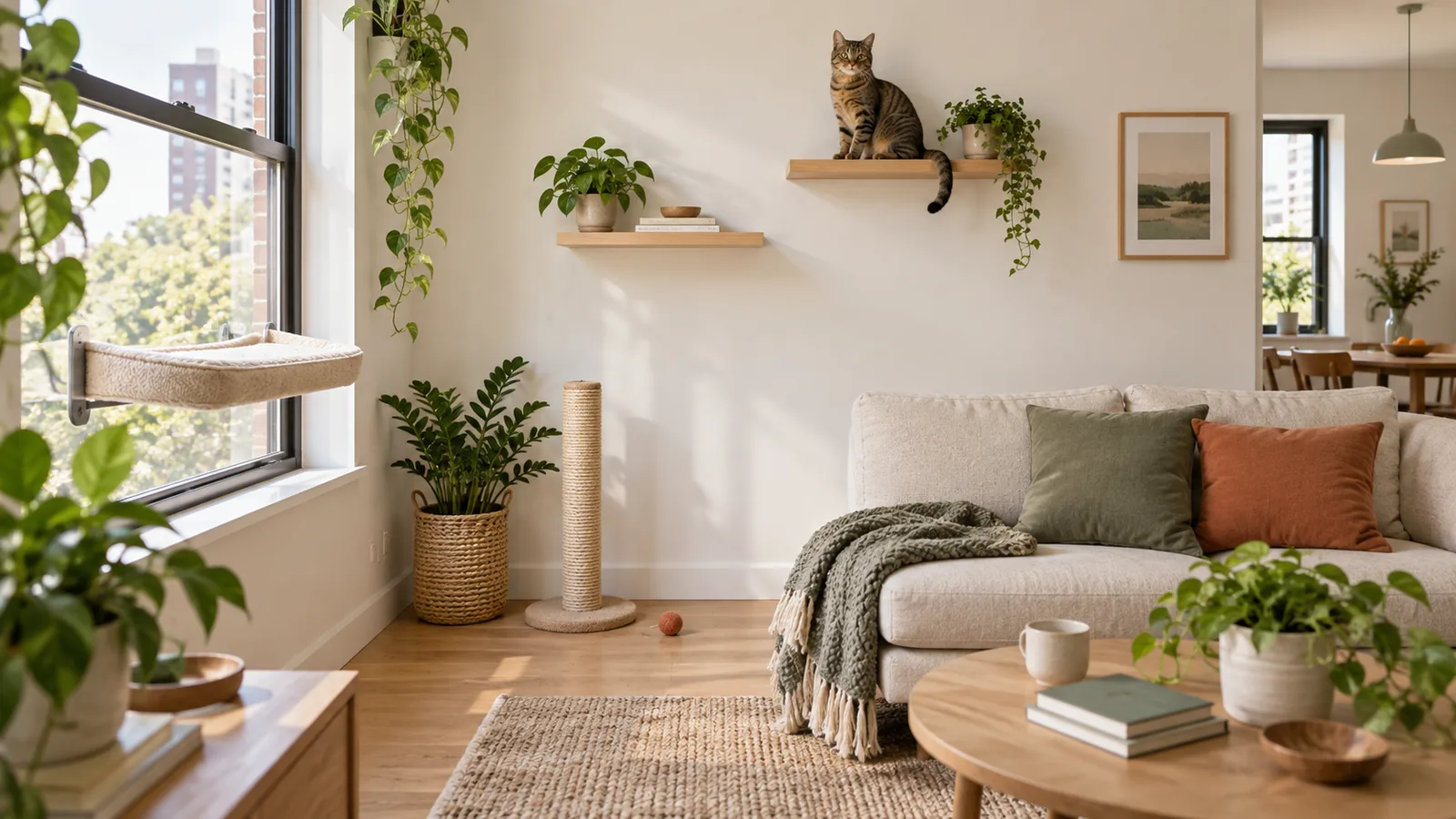
A small apartment can be a great home for an indoor cat. What matters isn’t the square footage. It’s how the space works for your cat: somewhere safe to hide, places to climb, things to hunt and a routine they can count on. This guide shows you how to set up all of that when you don’t have a spare room, a big yard or much floor space to give up.
Can a cat be happy in a small apartment?
Yes. Plenty of cats live long, contented lives in studios and one-bedroom apartments. Cats don’t measure their homes in square feet the way we do. They care about what they can do in that space: climb, look out, hide, scratch, play and rest without being disturbed.
A small apartment with a window perch, a couple of wall shelves and ten minutes of play a day often suits a cat better than a large house with nothing to climb and nobody home. The goal is to make the space you have more interesting, not bigger.
A few things do matter more in a small home:
- Vertical space. When the floor is taken, height is where your cat finds extra room.
- Separation. Food, water and the litter box shouldn’t all be in the same corner.
- Routine. In a small space, boredom shows up faster, so daily play matters.
How much space does a cat need?
There’s no official minimum. What a cat needs is enough room to move between separate areas for eating, sleeping, playing and using the litter box, plus a few places to get up high or tuck themselves away.
A useful way to think about it: count your cat’s territory in routes and spots, not square feet. A studio with a climbing route along one wall, a perch at the window and a hideout under the desk gives a cat far more usable territory than an empty living room twice the size.
The five pillars of a healthy indoor environment
Veterinarians have a helpful framework for this. The Feline Environmental Needs Guidelines, published in 2013 by the American Association of Feline Practitioners (AAFP) and the International Society of Feline Medicine (ISFM), describe five pillars of a healthy environment for cats. Here’s what each one looks like in a small apartment.
1. A safe place
Every cat needs somewhere to retreat where they feel protected and can watch without being seen. In a small apartment, that might be:
- A covered cat bed, a box on a shelf or a felt tunnel bed your cat can disappear into.
- The top level of a compact cat tree.
- A spot under the bed or desk that nobody disturbs.
Height counts as safety for many cats. A shelf above head height is a place to watch the room without being in the middle of it.
2. Multiple, separated key resources
Food, water, litter, scratching spots, play areas and resting places should be spread out, not stacked in one corner. Cats generally don’t like eating next to their litter box, and many prefer water away from food.
In a studio, this might mean the litter box in the bathroom, food in the kitchen area and water near the window. If you have more than one cat, give them more than one of everything so nobody has to compete.
3. Opportunities to play and hunt
Indoor cats still have the instincts of a hunter: watch, stalk, chase, pounce, catch. Without an outlet, that energy often turns into night-time zoomies, attacks on ankles or a cat who simply sleeps all day.
Short play sessions with a wand toy, ending with a real catch, give that sequence a satisfying finish. Interactive toys that move on their own, like a door-hanging teaser or an automatic rolling ball, give your cat something to chase while you’re busy at home. Food puzzles turn meals into a small hunt, and a felt puzzle box works on the same idea: your cat fishes a ball out through the holes. Our guide to interactive cat toys for indoor cats compares the main types and explains which are safe to leave out.
4. Positive, consistent, predictable interaction
Cats tend to do best when their day is predictable. Try to feed, play and settle at roughly the same times. Let your cat choose when to approach for attention, and respect it when they walk away. In a small home, this also means giving your cat quiet places to rest away from visitors, noise and the busiest part of the room.
5. Respect for your cat’s sense of smell
Smell matters much more to cats than to us. Strongly scented cleaners, air fresheners and scented litter can be unpleasant for them. Cats also mark their territory by rubbing and scratching, so a scratching post in a main room helps them feel at home. Wash cat beds with unscented detergent and avoid washing everything at once, so the space still smells familiar.
Use your walls and windows
In a small apartment, the floor is usually full. The walls and windows aren’t. That’s where most of your cat’s extra territory can come from.
Wall shelves and climbers. A route of cat wall shelves gives your cat somewhere to climb, perch and patrol without taking any floor space. A simple zigzag of three or four shelves up to a landing is enough to change how a cat uses a room. Our guide to cat wall shelf layouts and spacing covers planning and safe installation.
Window perches. A window is often the most interesting spot in an indoor cat’s day: birds, people, rain, light. A window perch or hammock turns that view into a comfortable seat. Our foldable window perch goes up with suction cups, no tools. Read how to choose and install a window perch safely before you buy one.
A compact cat tree. If you have a free corner, a slim cat tree adds height, a scratching post and a nap spot on a small footprint. See our guide to choosing a cat tree for a small apartment.
A simple daily routine
Enrichment doesn’t need hours. For most indoor cats, a routine like this goes a long way:
- Morning: a short play session before breakfast, then a food puzzle or scattered kibble to find.
- While you’re out: a window view, a perch in the sun and a toy or two left out.
- Evening: a longer play session (10 to 15 minutes, split into rounds), ending with a catch and then dinner.
- Before bed: quiet time together or a short brushing session.
Rotate toys every week or so. Put some away and bring them back later, and they’ll feel new again.
Signs your setup is working
You’ll usually see changes within a few weeks:
- Your cat uses the shelves and perches regularly.
- Fewer night-time zoomies and fewer ambushes on your ankles.
- More relaxed body language: stretching out, slow blinks, napping in open spots.
- Scratching on posts rather than the sofa.
If you’re not sure whether your cat is under-stimulated, read signs your cat is bored. If your cat is very active, an exercise wheel might help, although not every cat will use one.
When to talk to your vet
Enrichment helps with boredom, not illness. If your cat suddenly changes their behavior, stops eating, hides much more than usual, over-grooms, stops using the litter box or seems in pain, talk to your vet first. Those changes can have medical causes that no toy or shelf will fix.
Frequently asked questions
Can a cat live in a studio apartment?
Yes. Many cats live happily in studios. Give them vertical space, a window view, separate spots for food, water and litter, a hiding place and daily play.
Is it cruel to keep a cat indoors in an apartment?
No. Indoor cats avoid traffic, predators and many outdoor risks. What they need in exchange is an environment that lets them climb, hunt, scratch and rest. That’s what enrichment is for.
What’s the easiest first step?
A window perch and ten minutes of wand-toy play a day. Both are quick to set up and most cats respond right away.
Do indoor cats need a cat tree?
Not necessarily. They need height and a scratching surface. A cat tree does both on a small footprint, but wall shelves plus a scratching post can do the same job without using floor space.