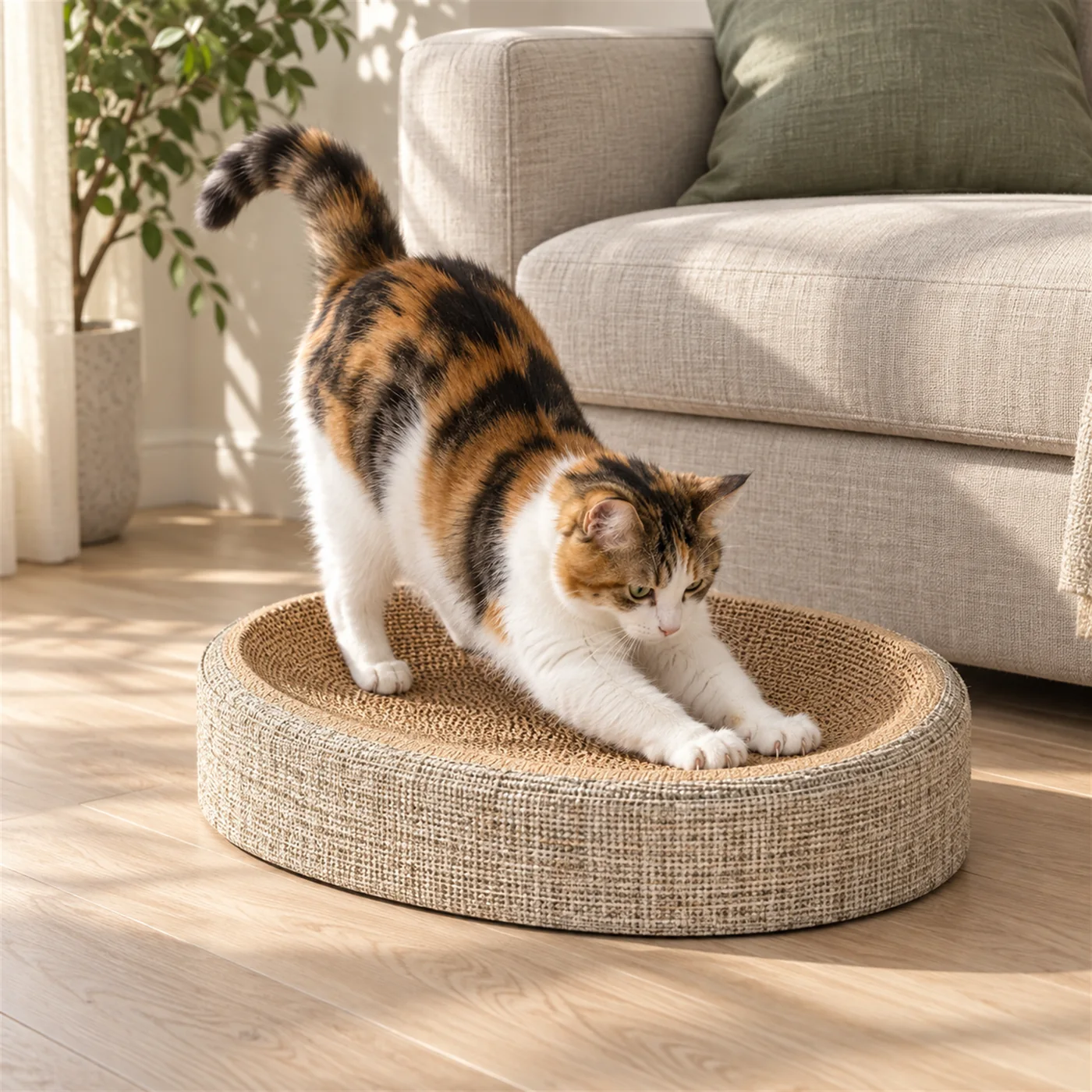
Your cat isn’t scratching the couch to annoy you. Scratching is a normal, healthy cat behavior, and the couch just happens to be the best scratching spot in the room. So if you’re looking for how to stop cat scratching the couch, the answer isn’t to stop the scratching. It’s to move it somewhere better. This guide explains why cats pick the sofa, how to choose and place a scratcher your cat will prefer, how to make the couch less tempting and what to avoid, with ideas that fit a small apartment.
Why cats scratch your couch
The ASPCA lists several reasons cats scratch: to remove the worn outer layer of their claws, to stretch, during play and to mark their territory. VCA Animal Hospitals explains that scratching leaves both a visual mark and a scent from glands in the paws, and that some cats scratch more when they’re anxious or in conflict.
That explains why the couch is so popular:
- It’s tall and sturdy. Your cat can stretch out fully and pull hard without it moving.
- The texture is right. VCA notes that cats like surfaces their claws can hook into and tear. Many upholstery fabrics do exactly that.
- It’s in the middle of everything. Scratching is partly a way of marking territory, so cats choose prominent spots in the rooms where their people spend time.
The goal is to offer something that beats the couch on all three counts.
Step 1: Choose a scratcher your cat will prefer
According to the ASPCA, a good scratcher is sturdy enough not to shift or collapse when used and tall enough for your cat to stretch fully. VCA adds that the post should be tall enough for your cat to scratch while standing on its hind legs.
Then match it to how your cat scratches now:
| If your cat scratches… | Choose | From our shop |
|---|---|---|
| The arm or back of the couch, standing up | A tall vertical scratcher | L-shaped cardboard cat scratcher (large, about 26.8 in), or the sisal posts on a cat tree |
| The seat cushions or the rug, lying down | A horizontal scratcher | Cardboard cat scratcher pad, cardboard cat scratcher bowl |
| Right after a nap | A scratcher that is also a bed | Cardboard cat scratcher bowl, a scratcher and a bed in one |
| Anything near the wall, and you have no floor space | A wall-mounted scratcher | Sisal scratching logs or the 41.3 in sisal climbing post from our cat wall shelves |
A few things to know about materials:
- Sisal, cardboard, wood and rough fabric are all popular with cats. The ASPCA suggests offering a variety, so try two textures if you’re not sure.
- Cardboard gives a satisfying shred and is easy to replace. It sheds a little as it’s used; that’s normal.
- Sisal lasts longer and suits cats who pull hard, like the thick posts on our floor to ceiling cat tree.
- Avoid tightly looped carpet, VCA advises, since it doesn’t give claws much to grip.
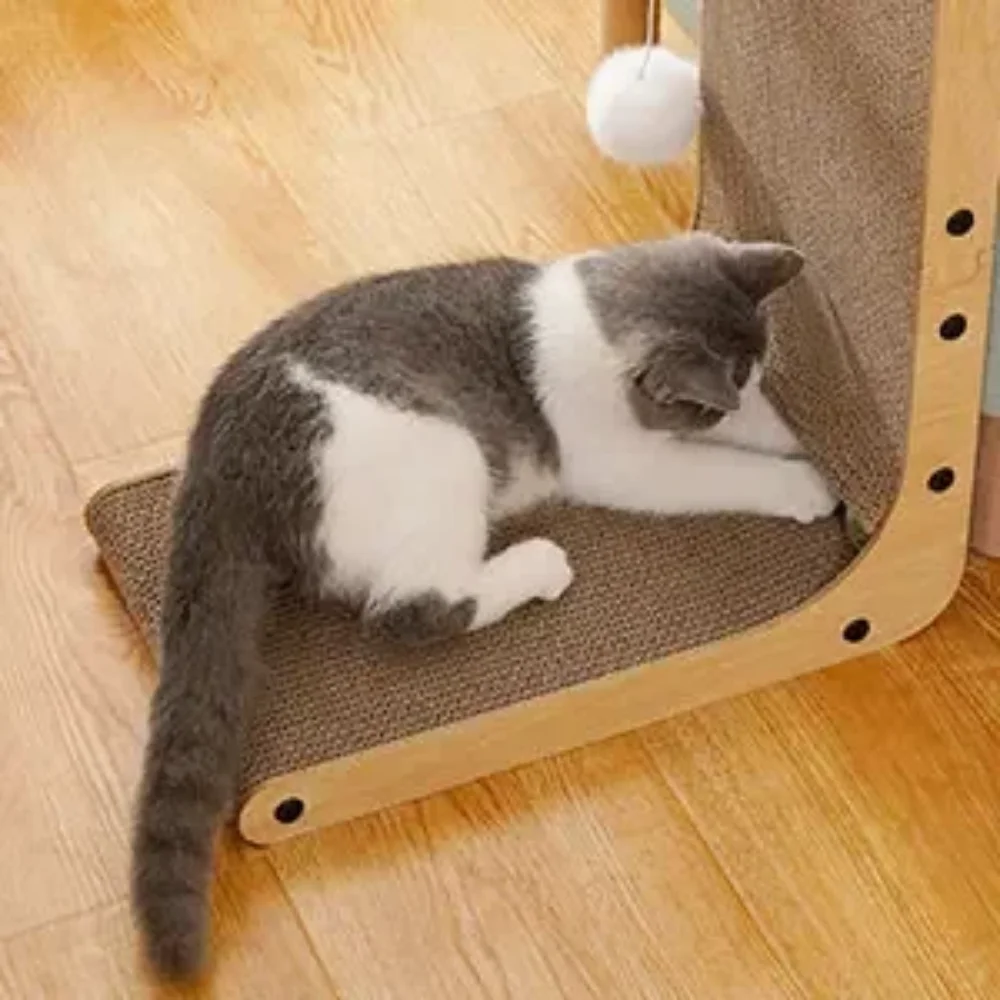
Step 2: Put it right next to the couch
Placement matters more than price. VCA says the most effective location is where your cat has already chosen to scratch, and the ASPCA recommends placing scratching posts right next to the furniture you want to protect.
So, at least at first, put the new scratcher directly in front of or beside the spot your cat uses: by the arm of the sofa for an upright scratcher, on the floor by the cushion for a flat one. Once your cat uses it every day, you can move it a little at a time to a spot you prefer, as VCA suggests.
A second scratcher near where your cat sleeps helps too, because many cats like to stretch and scratch as soon as they wake up.
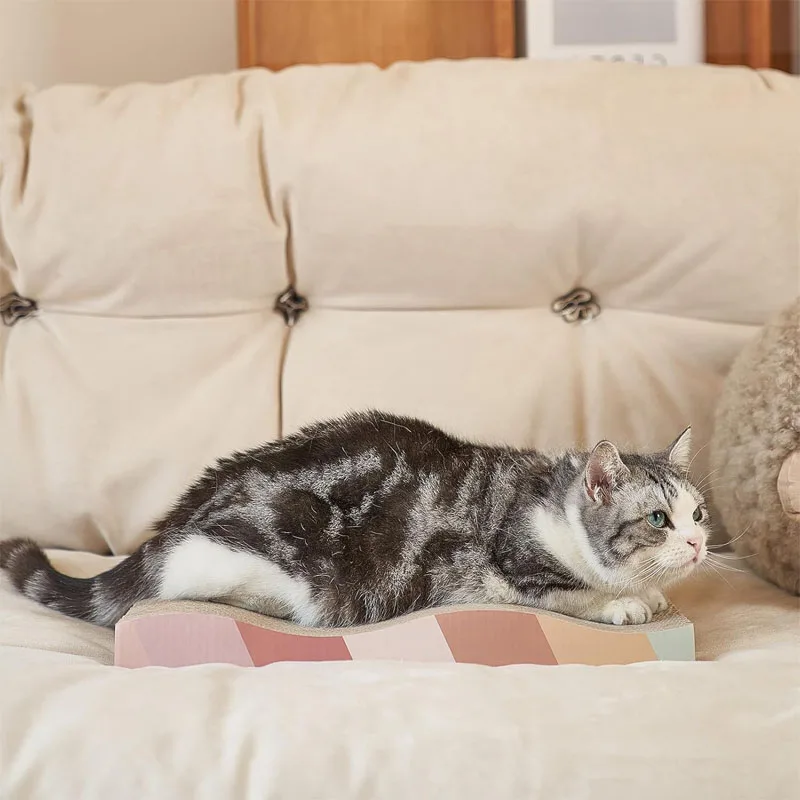
Step 3: Make the couch less appealing
While your cat learns to use the new scratcher, make the old spot unattractive for a few weeks. The ASPCA suggests covering the area with double-sided sticky tape, sandpaper or an upside-down vinyl carpet runner, knobby side up. VCA also mentions aluminum foil.
In a small apartment, the simplest option is often a fitted throw or a sofa cover over the arm your cat targets, plus a strip of double-sided tape where the throw doesn’t reach. Always test tape on a hidden area first, so it doesn’t mark your upholstery.
Take the deterrents away gradually once your cat is using the scratcher reliably.
Step 4: Make the scratcher the best spot in the room
A scratcher only works if your cat wants to use it:
- Add something interesting. The ASPCA suggests scenting posts with catnip and hanging toys on them. VCA mentions placing a food bowl nearby.
- Play near it. Drag a wand toy across and up the scratcher so your cat’s claws hit it during play. Our guide on how to tire out a cat before bed has an easy play routine.
- Reward every use. Give a treat or praise the moment your cat scratches the right spot. VCA recommends food rewards for scratching in the right place.
- Never force it. The ASPCA warns against putting your cat’s paws on the post and moving them, as it can put your cat off.
Step 5: Keep claws trimmed
Short claws do less damage while your cat is learning. VCA recommends keeping nails properly trimmed. A rechargeable nail grinder files the tip down a little at a time; stay well away from the pink quick, and ask your vet or groomer to show you if you’ve never done it.
Soft nail caps are another option. The ASPCA notes that plastic caps glued over the claws usually last four to six weeks.
What not to do
- Don’t punish your cat. VCA warns that physical punishment can make cats fearful or aggressive toward their owners. It also doesn’t teach your cat where to scratch instead.
- Don’t throw away a favorite worn scratcher. The ASPCA advises against it. A shredded scratcher is a well-loved one; add a new one beside it before you retire it.
- Don’t consider declawing. It’s surgery that removes the last bone of each toe. The AAFP, now the Feline Veterinary Medical Association, strongly opposes elective declawing, and the ASPCA says it is strongly opposed too. A growing number of US states, including New York, Maryland, Virginia and California, have banned elective declawing, dvm360 reports.
How long does it take?
How quickly you can stop cat scratching the couch depends on the cat and on how long the sofa has been the favorite spot. Some cats investigate a well-placed scratcher quickly; others need repeated rewards and more time. Keep the scratcher in place and remove the deterrents only after your cat is using it reliably. If your cat suddenly starts scratching much more than usual, think about stress: a new pet, a move or a change in routine. VCA notes that anxiety can increase scratching. Our guide to signs your cat is bored has ideas to help.
Frequently asked questions
Why does my cat scratch the couch when it has a scratching post?
Usually the post is too short, too wobbly, in the wrong place or covered in a texture your cat doesn’t like. Try a taller, sturdier scratcher placed right next to the couch, in the orientation your cat prefers, vertical or horizontal.
Does double-sided tape stop cats from scratching furniture?
It can help as a temporary deterrent. The ASPCA suggests double-sided tape, sandpaper or an upside-down carpet runner on the spot your cat uses, combined with a scratcher right next to it. Test the tape on a hidden area of the fabric first.
What’s the best scratcher for a small apartment?
One that does double duty: a scratcher bed or lounge your cat can also nap on, an L-shaped scratcher that stands against the wall, or a wall-mounted sisal post that uses no floor space.
Should I trim my cat’s claws to protect the couch?
Yes. Trimmed claws do less damage while your cat learns to use a scratcher. Take off only the clear tip and avoid the pink quick.
Is declawing a solution?
No. Veterinary groups including the AAFP oppose elective declawing, and several US states have banned it. Scratchers, deterrents and claw trims solve the problem without surgery.
Browse all our cat scratchers, see how a cat tree for a small apartment can double as a scratching post, or read the complete guide to indoor cat enrichment in small apartments.