
A Christmas tree is the most exciting thing that will appear in your apartment all year, at least from your cat’s point of view: something new to climb, shiny things that swing, a water bowl at the bottom and lights that blink. This guide explains how to cat-proof a Christmas tree step by step, from picking the tree and the spot to decorations, lights and the holiday plants that are toxic to cats, with extra ideas for small apartments where you can’t simply close the door on the living room.
Why cats love Christmas trees
To a cat, a Christmas tree looks like an indoor tree that appeared overnight. Cats like to climb and to watch from up high, and a tree offers branches to climb, places to hide underneath and ornaments that move when touched, which looks a lot like prey. In a small apartment, where the tree often ends up a jump away from the sofa or a shelf, it’s even harder to resist.
None of this means your cat is being naughty. It means your cat is being a cat. The goal isn’t to punish the interest but to make the tree boring, stable and safe, and to give your cat better things to do.
Are Christmas trees dangerous for cats?
The tree itself is rarely the biggest problem. What causes trouble is what comes with it:
- Tipping over. A cat climbing the trunk can bring the whole tree down. The ASPCA recommends securing the tree tightly so it can’t fall on a pet.
- Needles. According to PetMD, the needles of fir, spruce and pine are mildly toxic to cats if eaten, mainly because of their oils and sap. They can cause stomach upset and mouth irritation, and swallowed needles can also injure the digestive tract.
- Tree water. Cats often drink from the stand. PetMD warns that water additives such as fertilizers and preservatives can be harmful to cats, and the ASPCA advises keeping the water covered or out of reach.
- Tinsel and anything string-like. The ASPCA recommends skipping tinsel altogether: if swallowed, it can block the digestive tract and may need surgery.
- Ornaments. Shards from broken ornaments can damage a cat’s mouth and digestive tract, according to the ASPCA.
- Lights and cords. PetMD lists chewed Christmas lights and electrical cords as major hazards.
The good news: each of these risks has a simple fix, and you don’t need all of them at once. Combine a few and supervise, especially in the first days.
Real or artificial tree?
An artificial tree removes two problems: there’s no water to drink and no real needles to chew. PetMD notes that it avoids those risks, but that chewed plastic or metal can still irritate the stomach or cause a blockage, so it isn’t chew-proof either. Artificial trees are also lighter, which makes a sturdy, wide base even more important.
If you prefer a real tree, choose one that drops fewer needles, sweep under it every day and keep the water covered. Never add preservatives or other additives to the water if you have a cat.
How to cat-proof a Christmas tree: 12 steps
1. Choose a smaller tree with a heavy, wide stand
A shorter tree has less height to climb and does less damage if it tips. In a small apartment, a tree of about 4 to 5 feet is often easier to protect than a full-size one. Pick a stand that is wide and heavy for the size of the tree; PetMD suggests a heavy base or adding weights to it.
2. Put it where your cat can’t launch onto it
Place the tree in a corner, away from anything your cat can jump from: the back of the sofa, a bookcase, a windowsill, a cat tree or your wall shelves. Measure it like a cat would: if your cat can reach the branches in one jump from a piece of furniture, move the tree or the furniture.
3. Anchor the tree to the wall
Even a heavy stand won’t stop a determined climber. Tie the top third of the trunk to a hook in the wall or the ceiling with a sturdy cord or clear fishing line, pulled tight so it can’t hang loose. If you rent, use a removable hook rated for more than the weight of the tree, or tie it to something solid nearby.
4. Let your cat meet the bare tree first
Put the tree up and leave it undecorated for a few days. Your cat will sniff it, maybe try a branch or two, and slowly lose interest. Redirect any climbing calmly by moving your cat to a place they are allowed to climb, and reward them there. Decorate once the tree has become furniture.
5. Block the base
The base is where most climbs start. A small pet playpen or a decorative fence around the tree keeps paws away from the trunk, the stand and the lowest ornaments. Wrapped empty boxes stacked under the lowest branches also fill the gaps a cat uses to get in.
6. Cover the water
Cover the stand completely with a tree skirt fixed in place, a lid or a piece of netting so your cat can’t reach the water. Keep a fresh water bowl elsewhere in the apartment, so your cat isn’t tempted to look for a new one.
7. Skip tinsel and all string-like decorations
No tinsel, angel hair, garland made of thin strands, curling ribbon or loose strings of beads. Cats’ tongues have tiny backward-facing barbs, so anything long and thin is hard for them to spit out once it’s in their mouth. This is the single most important rule on this list.
8. Hang ornaments high and securely
Keep the bottom third of the tree bare, or use only soft, unbreakable ornaments there. Put glass, homemade salt dough and anything small enough to swallow near the top. Attach ornaments firmly, closing hooks around the branch or using clip-on hangers, so they don’t swing loose or fall off at the slightest touch. A dangling ornament is an invitation to bat it.
9. Make the lights cat-safe
- Wrap the lights close to the trunk and toward the inside of the tree, not on the tips of the branches.
- Run the cord from the tree to the outlet along the wall, inside a cord protector, as PetMD suggests.
- Turn the lights off and unplug them whenever you go out or go to bed.
- Battery-powered lights avoid the wall cord entirely. If you use them, hide the battery pack deep in the tree; the ASPCA advises keeping batteries out of paws’ reach.
10. Use safe deterrents, not sprays
Many cats dislike the feel of aluminum foil or a sticky surface under their paws, so foil around the stand or a plastic carpet runner turned nub-side up around the tree can discourage them. Skip citrus sprays and anything made with essential oils: the Ontario SPCA warns that cats are especially sensitive to essential oils because their liver can’t break them down well. Never use a water spray or shout at your cat; it teaches them to climb when you’re not looking.
11. Give your cat a better place to climb
A cat who already has a tall, stable place to climb and watch from has less reason to try the Christmas tree. If your cat doesn’t have one, the holidays are a good time to add it, far from the Christmas tree:
- A cat tree with a high perch, like the 5-level cat tree with hammock and condo or the cactus floor-to-ceiling cat tree, which reaches the ceiling and has its own green “branches”. See all cat trees.
- Modular cat wall shelves to build a climbing route that takes no floor space. Plan the layout with our cat wall shelf ideas.
- A window hammock so your cat can watch the birds instead of the ornaments.
Sprinkle a little catnip or put a treat on the new spot, and reward your cat every time they use it.

12. Tire your cat out before the tree gets interesting
Most tree climbing happens when a cat is bored or full of energy, often in the evening and at night. Ten to fifteen minutes of active play before you go to bed or leave the apartment makes a big difference. Our guide on how to tire out a cat before bed explains a simple routine.
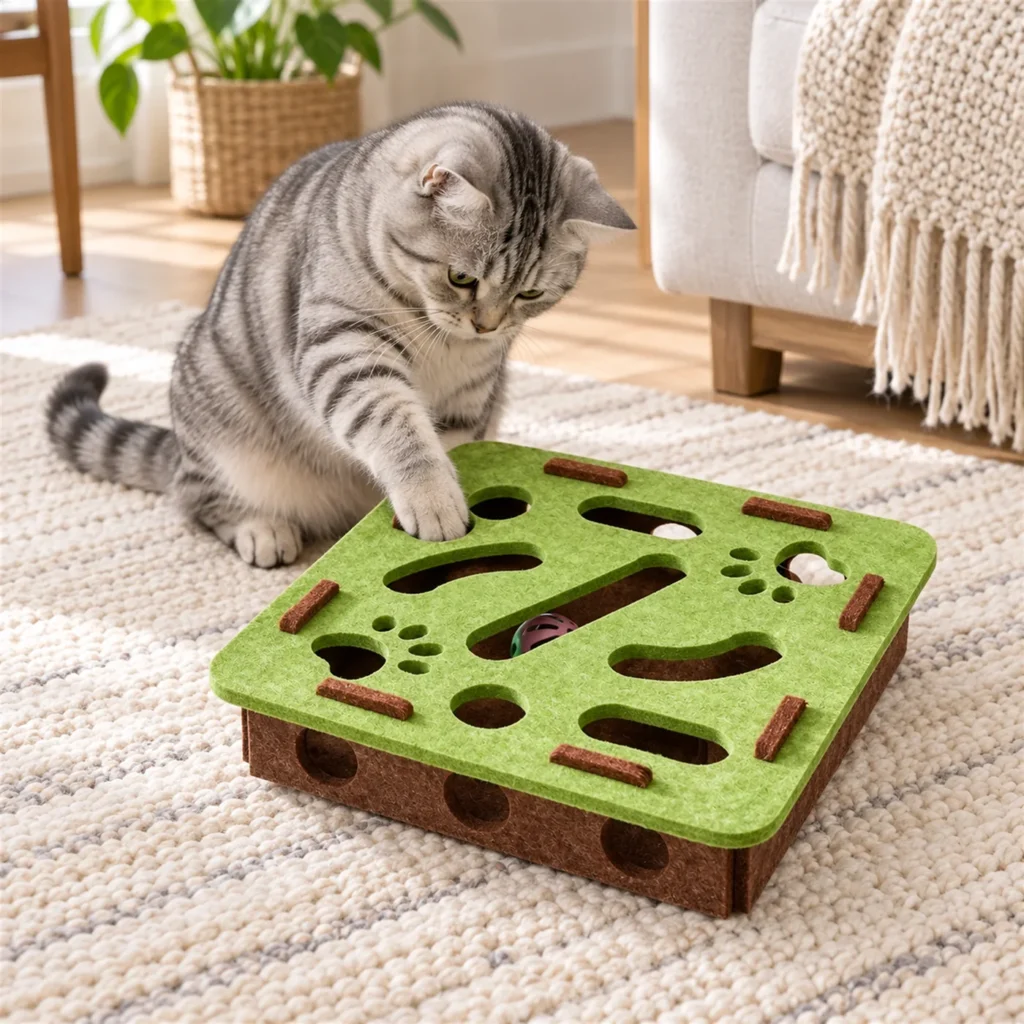
Toys without strings are the safest choice during the holidays. A felt puzzle box, where your cat fishes a bell ball out through the holes, keeps them busy on the floor, far from the ornaments. Put wand toys and toys with tails or feathers away after each play session. More ideas in our guide to interactive cat toys for indoor cats.
Christmas tree ideas for small apartments
In a studio or one-bedroom there’s often no room you can close off, and the tree ends up next to the sofa. A few alternatives that work well:
- A tree inside a playpen. A small tree inside a pet playpen, with the presents inside too, is the easiest way to protect both.
- A tree in a room you can close. If you have a bedroom or a home office, put the tree there and close the door whenever you can’t supervise.
- A wall tree. A flat tree made from felt, wooden slats or branches fixed to the wall gives you the look without a trunk to climb. Hang it high, use no tinsel and keep cords out of reach.
- A small tree on a high, stable surface. Only if your cat can’t reach that surface in a jump from nearby furniture, and only if the tree is fixed so it can’t be pulled over.
Other holiday hazards for cats
The tree isn’t the only new thing in the apartment in December. The ASPCA highlights these:
- Lilies are highly toxic to cats and can cause kidney failure. Keep them out of a home with cats completely, including in holiday bouquets.
- Poinsettias can cause mild to moderate stomach upset.
- Holly and mistletoe can cause stomach upset and heart problems if eaten.
- Candles should never be left burning unattended.
- Gift wrap ribbon is another string-like hazard: clear it away as soon as presents are opened.
- Food gifts under the tree: keep wrapped food and chocolate off the floor.
Artificial plants are a safer way to decorate.
What to do if your cat eats tinsel or chews a wire
- String, tinsel or ribbon: if you see a piece hanging from your cat’s mouth or rear, don’t pull it. PetMD advises against pulling and against making your cat vomit, and recommends going to a vet or emergency clinic immediately.
- A chewed cord: unplug the lights before you touch your cat, then call your vet, even if your cat seems fine.
- A toxic plant, tree water or anything else: call your vet or the ASPCA Animal Poison Control Center at (888) 426-4435. A consultation fee may apply.
Watch for vomiting, drooling, not eating, lethargy or a painful belly after any holiday mishap, and contact your vet if you see them.
Frequently asked questions
Are Christmas trees toxic to cats?
The needles of fir, spruce and pine are mildly toxic to cats if eaten and can cause stomach upset and mouth irritation. The bigger risks are tree water with additives, tinsel, broken ornaments and chewed light cords.
Does aluminum foil keep cats away from a Christmas tree?
Many cats dislike walking on foil, so it can help around the stand. It won’t stop a cat who jumps onto the branches from furniture, so combine it with a good location, an anchored tree and a blocked base.
What is the best Christmas tree for a home with cats?
A small artificial tree on a heavy, wide stand, anchored to the wall and placed away from furniture your cat can jump from. If you choose a real tree, keep the water covered and sweep up needles daily.
How do I stop my cat climbing the Christmas tree?
Anchor the tree, block the base, keep the lower branches bare and give your cat a place to climb that they’re allowed to use, like a cat tree or wall shelves. Daily play helps too, because a tired cat is less interested in the tree.
Should I wait to decorate the tree?
Yes, if you can. Leave the tree bare for a few days so your cat gets used to it, then decorate from the top down, keeping the lowest branches nearly empty.
Shopping for the cat or for a cat lover this year? See our gifts for cat lovers for ideas, or read the complete guide to indoor cat enrichment in small apartments.