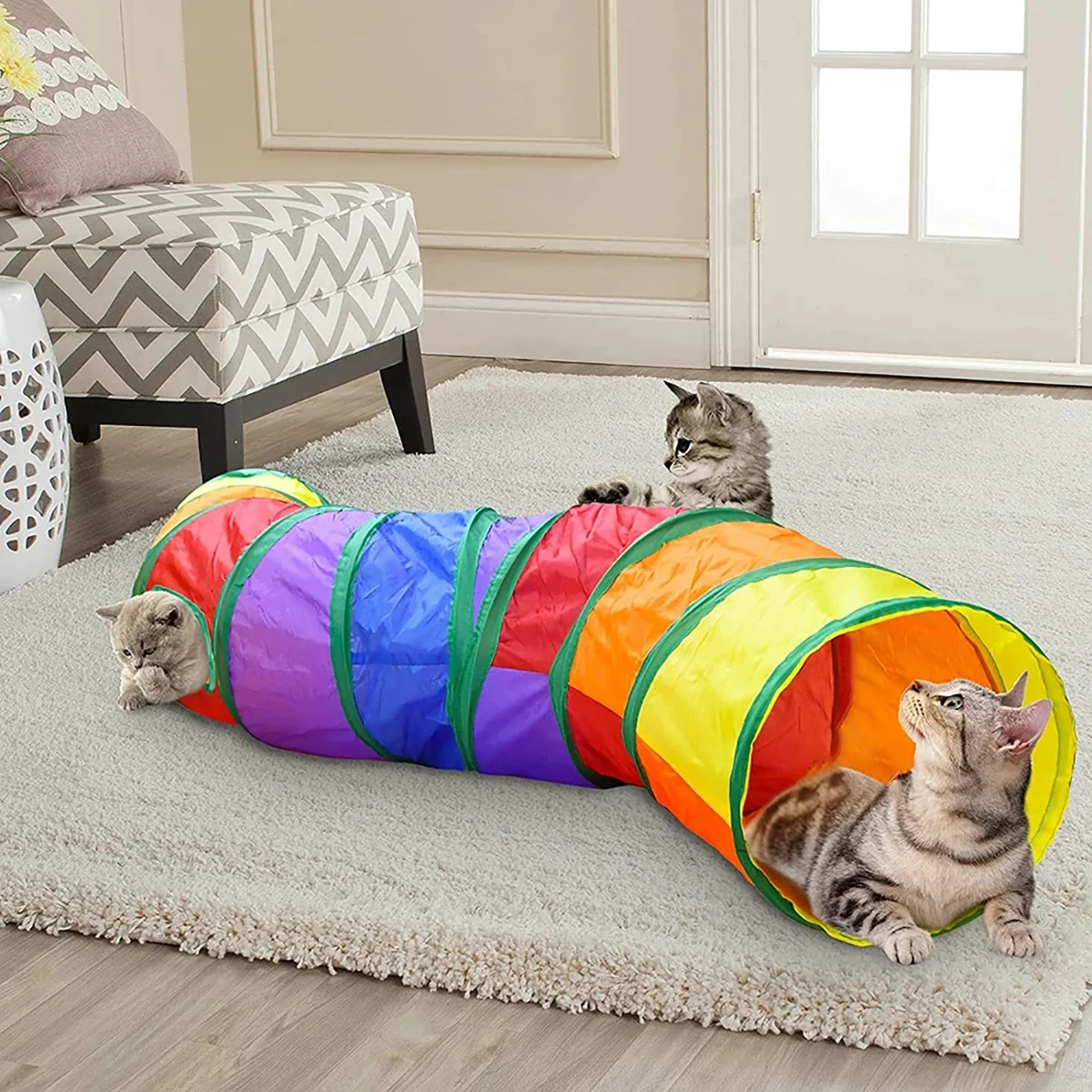
Do cats like tunnels? Many do, and for good reasons. A tunnel is a hiding place, an ambush spot and a racetrack in one, which is exactly what an indoor cat in a small apartment is often missing. This guide explains why cats love tunnels and hideaways, how to tell if your cat would use one, the difference between a play tunnel and a tunnel bed, how to get a reluctant cat interested and how to keep tunnel play safe.
Do cats like tunnels? The short answer
Many cats do, but not all of them in the same way. Some race through a tunnel at full speed, some lie in wait inside it and pounce on anything that passes, and some simply use it as a quiet place to nap out of sight. A few cats ignore tunnels completely, especially at first.
Cats benefit from access to safe hiding places, though individual preferences differ. A tunnel is one of the easiest ways to provide one in a home where space is tight.
Why cats love tunnels and hiding spots
Hiding helps cats feel safe. International Cat Care explains that taking time out from social demands is an essential part of everyday life for a cat, which is why secret hideaways matter. It suggests places under the bed, inside cupboards or behind the sofa, as well as boxes and paper bags.
Hiding helps cats cope with stress. In a small 2014 study by Utrecht University, 19 newly arrived shelter cats were assigned either a hiding box or no hiding box. The cats with a box had lower average stress scores on days 3 and 4 and reached the group’s day-14 stress level by about day 3. This supports providing hiding places during stressful transitions, but the study examined shelter cats and hiding boxes—not household play tunnels.
Tunnels match how cats hunt. Cats are ambush predators. They watch from cover, stalk and pounce. A tunnel gives them cover to hide in and a place to burst out of, so it turns ordinary play into a proper hunting game.
They’re a place to run. A tunnel on the floor gives a high-energy cat a short track for zoomies, which is welcome in an apartment without stairs or long hallways.

Signs your cat would enjoy a tunnel
Your cat is likely to use a tunnel if they:
- Hide under the bed or in boxes whenever they get the chance
- Ambush your ankles from behind furniture
- Get the zoomies, especially in the evening
- Are shy or new to your home, and need a safe place to watch from
- Live with another cat and need a way to avoid each other without a standoff
Play tunnel or tunnel bed?
There are two main types, and they suit different cats:
| Collapsible play tunnel | Felt tunnel bed | |
|---|---|---|
| Best for | Chasing, ambushing, zoomies | Hiding, napping, shy cats |
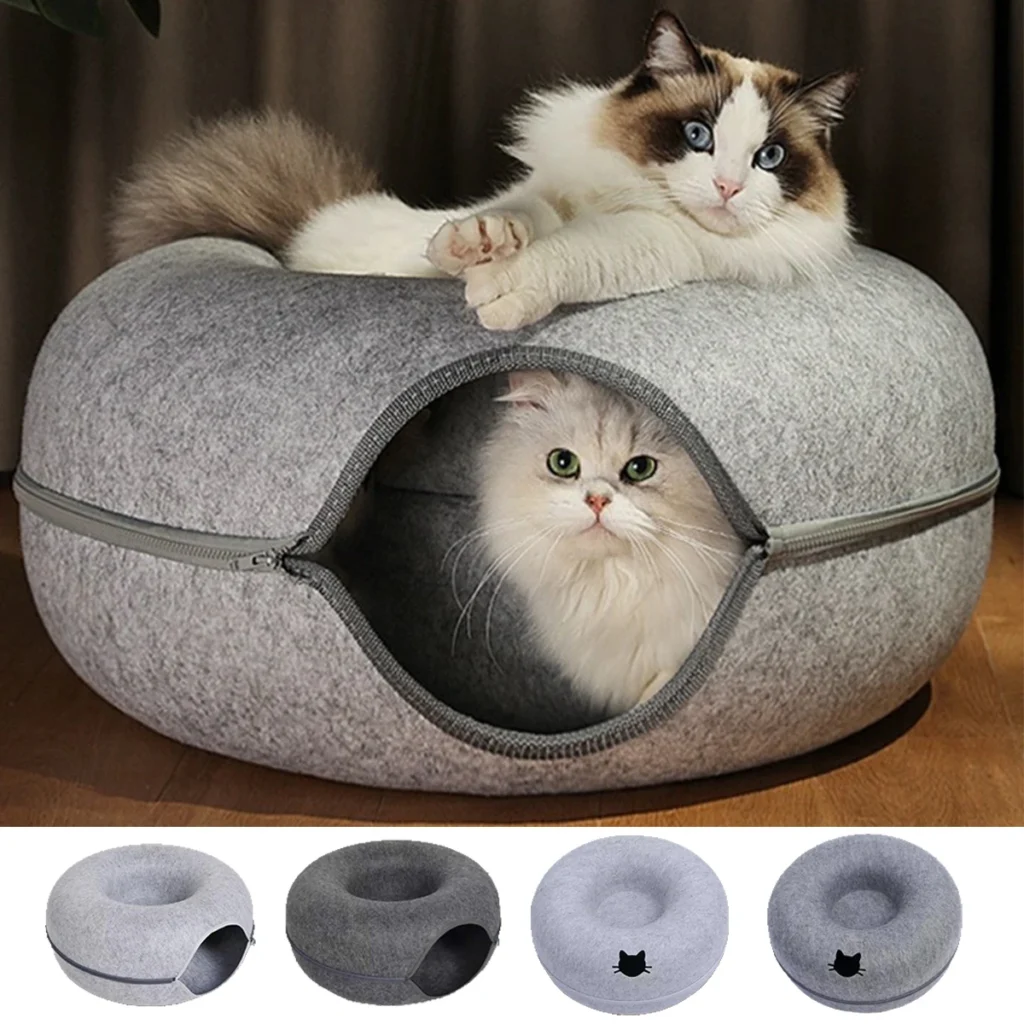
| How it works | A fabric tube on a spring frame, often with peek holes | A thick felt donut: a bed on top, a tunnel inside |
| Small-apartment bonus | Folds flat to store under the sofa | Doubles as a cat bed, so it earns its floor space |
| From our shop | Collapsible cat tunnel, about 9.8 in across, from a 20 in short tunnel to a 48 in S-tunnel | Felt cat tunnel bed, medium (19.7 in) or large (23.6 in), unzips into two halves |
Choosing a size: the manufacturer of our felt tunnel bed sizes the medium for cats up to about 8.8 lb and the large for cats of about 8.8 to 17.6 lb. For play tunnels, a longer S-shaped or three-way tunnel gives more places to hide and pounce from; a short 20 in tunnel suits kittens and tight spaces.
Prefer to start free? A sturdy cardboard box on its side, or a paper bag with the handles cut off, is a good way to test whether your cat likes hiding spots before you buy anything.
How to get your cat to use a tunnel
Some cats dive in straight away. Others need a little encouragement:
- Put it in the right place. Along a wall, near where your cat already likes to rest, or on a route they use every day. Cats are more confident when they can see what’s coming.
- Make it rewarding. Toss a treat or a favorite toy just inside the entrance, then a little deeper next time.
- Play through it. Slowly drag a wand toy into one end and out of the other, and let your cat chase it through. Our bird wand cat toy works well for this.
- Add a little catnip inside, if your cat reacts to it.
- Never push your cat in or block the exits. Let them explore at their own pace, and keep both ends open so they never feel trapped.
Some cats explore a new tunnel right away; others need more time. If yours ignores it at first, leave it available without forcing interaction and keep incorporating it into play. Remove it if your cat consistently avoids it or appears stressed by it.
Keep tunnel play safe
- Remove dangling toys when you’re out. Many tunnels come with a ball on a string. VCA Animal Hospitals explains that string and similar long, thin objects can cause a serious intestinal blockage if swallowed, so unhook them when nobody’s watching.
- Check for damage. Replace a tunnel if the fabric tears or any part of the wire frame pokes through.
- Give it room. Keep tunnels away from stairs, balconies and anything that could fall on them when your cat races through.
The tunnel itself, without dangling toys, makes a good hideout to leave out while you’re away. See more ideas in our guide to interactive cat toys for indoor cats.
Tunnels in a small apartment
Tunnels are one of the most space-friendly ways to add enrichment:
- Fold it away. A collapsible tunnel goes flat under the sofa or bed when you need the floor back.
- Pick double-duty pieces. A tunnel bed is a bed and a hideout; a cat tree with a condo adds a hiding spot up high.
- Rotate. Put the tunnel away for a week and bring it back. Like toys, it often feels new again.
- Combine it with height. Hiding spots on the floor and lookouts up high, like a window perch or wall shelves, give your cat a full territory without extra square feet. Our guide to indoor cat enrichment in small apartments shows how to plan it.
Frequently asked questions
Do cats like tunnels?
Many cats do, although preferences vary. They may use tunnels to hide, to ambush toys and other pets and to run through during the zoomies. Some cats need time and a little encouragement with treats or a wand toy before they use one.
Why does my cat like to hide in tunnels?
Hiding helps cats feel safe and in control. International Cat Care describes secret hideaways as an important part of a cat’s everyday life, and research on shelter cats found that a hiding box helped cats settle faster in a new place.
Are cat tunnels safe to leave out when I’m not home?
Yes, once you remove any dangling ball or string toy. String can be dangerous if swallowed, so those parts are only for supervised play.
What size cat tunnel should I get?
Many play tunnels are about 9 to 10 inches across. Compare the opening with your cat’s body size and choose a wider tunnel for a large cat; your cat should be able to enter, turn and exit without squeezing. For a tunnel bed, also check the manufacturer’s weight guidance.
Do older cats use tunnels?
Many do, especially as a quiet place to rest. A low, soft tunnel bed is often more appealing to an older cat than a long play tunnel.
Browse our interactive cat toys, read signs your cat is bored (and 12 fixes), or see our first time cat owner checklist if you’re just getting started.