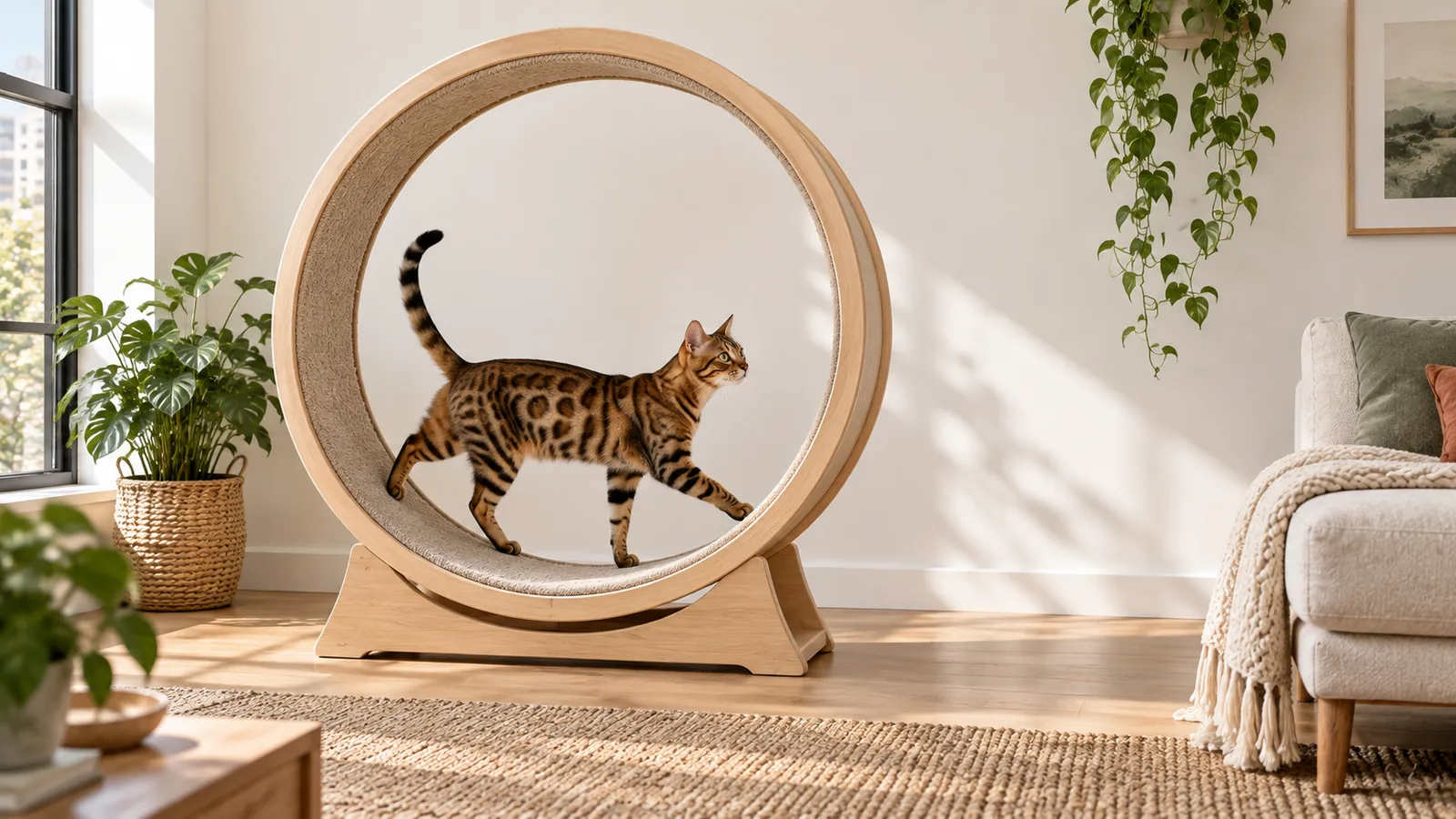
A cat exercise wheel is one of the bigger purchases you can make for an indoor cat, and one of the most divisive. Some cats take to it in a day and run every evening. Others walk past it for weeks. This honest guide explains which cats benefit, what to check before you buy, how to train your cat to use it and when a wheel isn’t the right choice.
What a cat wheel does
An exercise wheel lets a cat run in place. For a high-energy indoor cat, especially in a small apartment where there’s no long hallway to sprint down, it can be an outlet for the burst of energy that often turns into night-time zoomies, ankle attacks or knocked-over plants.
It isn’t a replacement for play. The hunting sequence of watch, stalk, chase, pounce and catch is what cats need most, and the AAFP/ISFM Feline Environmental Needs Guidelines list opportunities for play and predatory behavior as one of the five pillars of a healthy indoor environment. A wheel adds running on top of that.
Is a cat wheel worth it? It depends on your cat
A wheel is often a good fit for:
- Young, active cats with lots of energy.
- Curious, confident cats who like to explore new things.
- Active breeds often described as high-energy, such as Bengals, Abyssinians and Siamese.
- Cats who race around the apartment every evening.
- Homes with no space for long runs.
A wheel is often not worth it for:
- Senior cats and cats with joint, heart or mobility problems (ask your vet first).
- Very laid-back cats who prefer napping in the sun.
- Very nervous cats, who may be frightened by moving equipment.
- Homes where there’s no wall space for a large, fixed piece of furniture.
If you’re not sure, try more play and climbing first. A wall shelf route and two daily sessions with interactive toys, plus a toy that runs on its own like an automatic rolling ball, are cheaper and suit almost every cat. See our guide to interactive cat toys.
Pros and cons of a cat exercise wheel
| Pros | Cons |
|---|---|
| A way for active cats to run indoors | Not every cat will use it |
| Can help with evening restlessness | Takes up a large, fixed space |
| Can be used any time of day | One of the more expensive cat products |
| Adds activity without you needing to play | Most cats need training at first |
| No drilling needed | Can be noisy on hard floors |
What to check before you buy
Size
The inner diameter is the most important measurement. Your cat needs to run with a straight back, not a curved one. Larger cats and long breeds need a bigger wheel. Compare the inner diameter on the product page with your cat’s size, and check the overall height and depth against the space you have. On Nine Loofts, the “Will it fit?” guide on each product page shows the wheel next to a standard 80-inch door. Our wooden exercise wheel comes in two sizes: M, 35.8 in across with a 31.5 in inner diameter, and XL, 43.3 in across with a 39.4 in inner diameter for larger cats.
Running surface
Look for a surface with enough grip that your cat’s paws don’t slip, but with no gaps where claws or toes could catch. A carpet track that lifts out, like the one on our wheel, is easier to keep clean.
Stability and noise
A wheel should sit flat and still, without rocking as it spins. Quiet bearings and a rug underneath help if you have neighbors below.
Weight limit
Check the maximum weight in the product specs and stay within it.
Assembly
Most wheels arrive flat-packed. Check how much assembly is involved and that all screws can be tightened again later.
Where to put a cat wheel in a small apartment
- On a flat, stable floor against a wall.
- Away from stairs, furniture edges and doors, so your cat can get on and off safely.
- Near where your cat already likes to play, not tucked away in a spare room.
- On a rug or mat to reduce noise.
How to get your cat to use a cat wheel
Most cats need to learn how the wheel works. Keep sessions short, positive and never forced.
- Let your cat explore it while it’s still. Put treats inside and let them sniff and sit in it.
- Reward every step. Treat your cat for stepping in, then for standing in it, then for walking a few steps.
- Use a wand toy or a laser dot to lead your cat forward along the running surface, so the wheel turns slowly. End laser play with a real toy to catch.
- Keep it short: a few minutes at a time, ending on a good note.
- Repeat daily. Some cats get it in a day or two. Others take a few weeks.
- Never force your cat onto the wheel or spin it with them inside.
Many owners find that once a cat understands the wheel, they start using it on their own, often in the evening.
Safety tips
- Supervise the first sessions until you know your cat can get on and off confidently.
- Keep small children and other pets away from a moving wheel.
- Check the frame and screws regularly and tighten anything loose.
- Stop if your cat seems distressed and try again later with shorter sessions.
- Ask your vet first if your cat is older, overweight or has joint, heart or mobility problems.
The honest verdict
For a young, active cat in a small apartment, an exercise wheel can be a great addition. It gives them a place to run that your apartment otherwise doesn’t have. For a calm cat, a senior or a cat that’s fine with daily play, it’s probably not worth the space or the money.
If you decide to try one, measure carefully, be patient with training and keep daily play in the routine. And if your cat simply doesn’t take to it, our Refund & Return Policy gives you 30 days from delivery to return it.
Frequently asked questions
Do cats actually use exercise wheels?
Some do, enthusiastically. Others never take to them. Young, active and curious cats are the most likely to use one, usually after some training with treats and toys.
How long does it take to train a cat to use a wheel?
It varies from a day or two to several weeks. Short, positive sessions every day work best.
Are cat wheels safe?
A well-built wheel of the right size, on a flat floor and used as the manufacturer describes, is generally safe for healthy cats. Supervise at first and ask your vet if your cat has health problems.
What size cat wheel do I need?
One large enough for your cat to run with a straight back. Check the inner diameter against your cat’s size, and choose a bigger wheel for large or long cats.
Browse our cat exercise wheels, or read signs your cat is bored and the complete guide to indoor cat enrichment in small apartments.