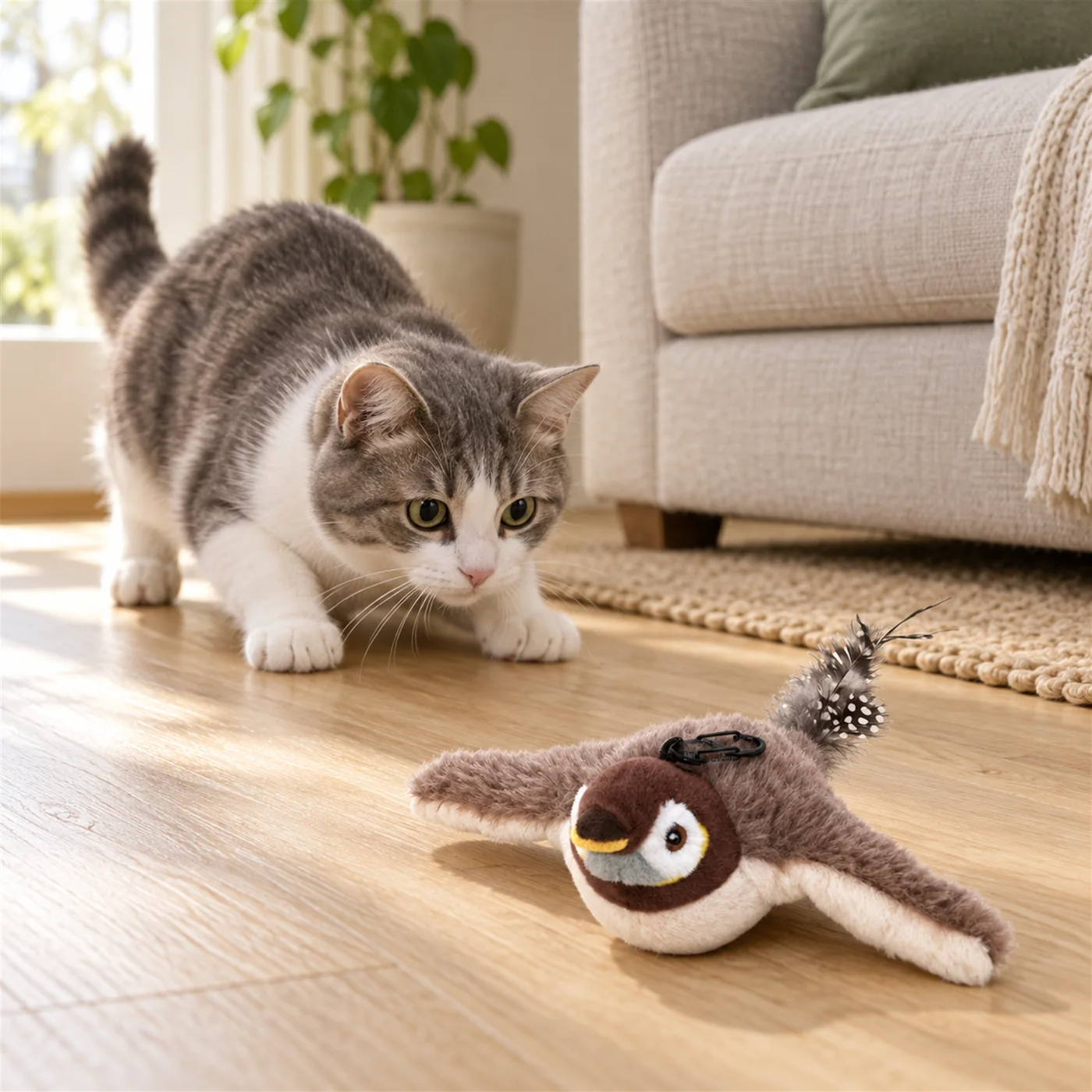
If your cat races down the hallway at midnight or sits on your chest at 5 a.m., you’re not alone. The good news is that most night-time chaos can be fixed with the right evening routine. This guide explains how to tire out a cat before bed, step by step: why cats get the zoomies at night, a simple evening play-and-feed routine, the best toys for the job and how to stop the early wake-up calls for good.
Why cats get the zoomies at night
Cats are crepuscular: they’re naturally most active around dusk and dawn, the times when their prey is out. VCA Animal Hospitals, in an article by two board-certified veterinary behaviorists, explains how this plays out in many homes: while their people are at work or school, cats spend the day resting. Their “day” starts when you come home, and the energy they’ve saved often spills over into the night.
In a small apartment there’s also less to do between naps: no stairs to run, no long hallway, no view from every room. A cat with too little activity in the day will often make up for it in the evening, at night or at dawn.
Short bursts of running around are normal cat behavior. Nightly laps, yowling at the bedroom door or pouncing on your feet under the covers usually mean your cat needs more to do earlier in the day, or a better routine at bedtime.
First, rule out a health problem
Before you change the routine, make sure there isn’t a medical reason behind the night activity, especially if it started suddenly. The RSPCA advises talking to your vet first to rule out causes such as pain or thyroid disease.
This matters most for older cats. According to the Cornell Feline Health Center, signs of cognitive dysfunction usually become noticeable in cats aged 10 or older and can include loud vocalizing in the middle of the night. Vets rule out other conditions first, including hyperthyroidism, high blood pressure, kidney disease and arthritis.
Call your vet if your cat’s night-time behavior is new, if your cat is a senior, or if it comes with other changes: eating more or less, weight loss, drinking more, litter box changes or hiding.
How to tire out a cat before bed: the evening routine
The routine below is built on a simple idea from cat behavior: a cat’s natural sequence is hunt, catch, eat, groom and then sleep. Jackson Galaxy, the cat behaviorist, recommends ending the day with an energetic play session followed by the last meal, so your cat winds down the way it would after a successful hunt.
Adjust the times to your own bedtime. This example assumes lights out around 11 p.m.
- During the day: give your cat something to do. Leave a view: a window perch or a clear windowsill in the sun. Scatter part of the day’s food in a few spots or use a food puzzle. Before you leave in the morning, a short play session helps too.
- Early evening, when you get home: the main play session. Ten to fifteen minutes of real hunting play with a wand toy. PetMD recommends two or three play sessions of 10 to 15 minutes a day, adjusted for your cat’s age and energy, and notes that a few short sessions work better than one long one.
- About an hour before bed: the “last hunt”. Another 10 to 15 minutes of play. Start slowly, build up to fast chases and jumps, then slow the toy down and let your cat catch it several times. Always end on a catch.
- Straight after: the last meal. Serve dinner, or a portion of the day’s food kept back for bedtime, right after the last hunt. The RSPCA suggests feeding one meal earlier in the evening and another closer to bedtime. Keep the total amount of food the same, so your cat isn’t overfed.
- Then: quiet time. Dim the lights, put the toys away and let your cat groom and settle. After a good hunt and a meal, many cats settle down to groom and sleep.
Keep the routine at roughly the same times every day. Cats like predictability, and the routine works best once your cat expects it.
How to play so your cat actually gets tired
Not all play is equal. Batting a toy that lies still for a minute won’t tire most cats out. What does is play that follows the hunting sequence:
- Move the toy like prey. Prey runs away from the cat and hides; it never walks up to the cat. Drag the toy along the floor, behind furniture, into a tunnel, then out again.
- Mix speeds and heights. Slow stalking, then a sudden dash. Short hops and a few higher jumps for cats who like to leap.
- Let your cat win. A cat that never catches anything gets frustrated, not tired. Let them catch the toy every few chases.
- Watch for the signs. Panting, lying down mid-game or losing interest mean it’s time to slow down and finish with a catch. Cats sprint rather than run marathons, so a few minutes of real effort goes a long way.
- Never use your hands or feet as the toy. It teaches your cat that people are prey, which is exactly what you don’t want at 3 a.m.
The best toys to tire out a cat
- A wand toy, used by hand. Still the best toy for evening play, because you control the chase. Our bird wand works as a classic hand-held wand, and its suction cup base lets the bird keep bouncing on its own while you’re in the room.
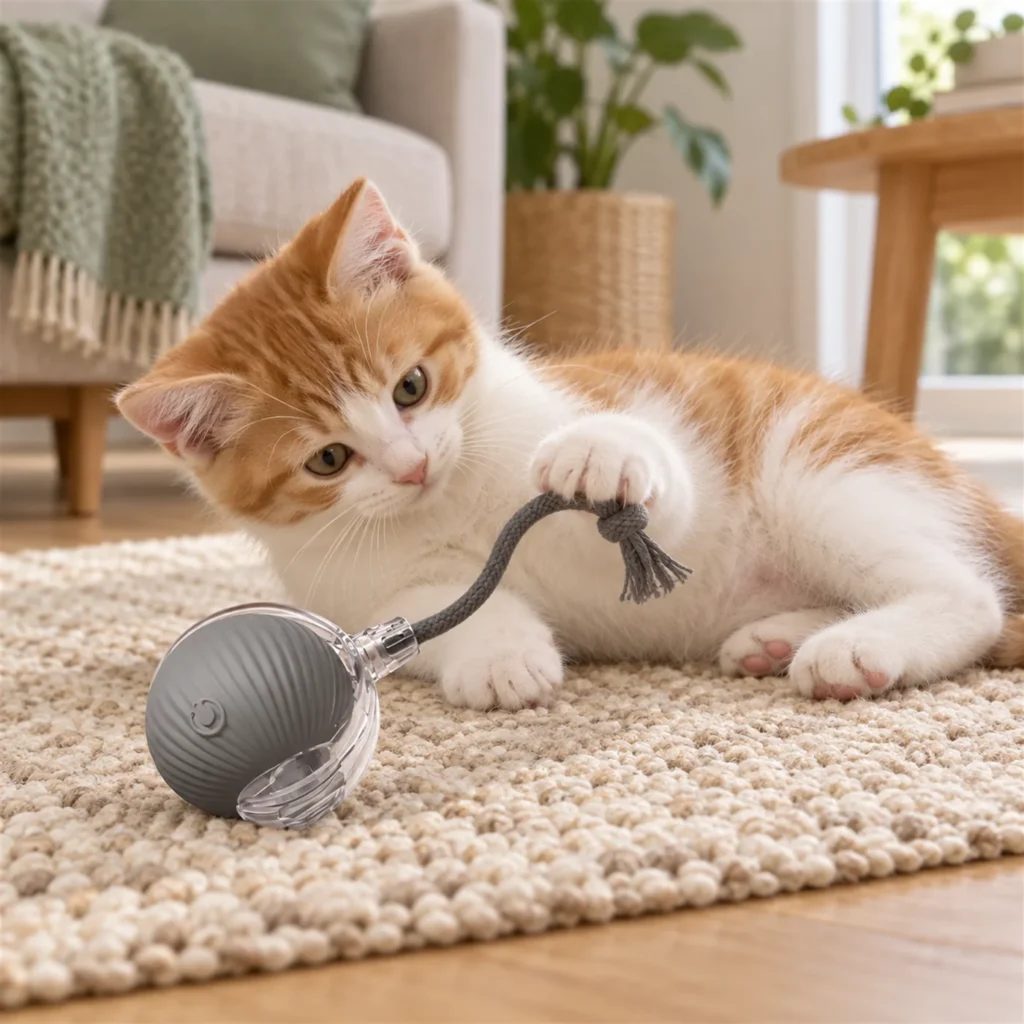
- A toy that runs away. An automatic rolling ball rolls off in random directions and drags a tail behind it, which is ideal for the chase part of the session on hard floors and low rugs.
- Something to jump for. A door-hanging electric teaser lifts and drops two toys from a door frame, for cats who love to leap.
- A tunnel for ambush games. Pulling a wand toy through a collapsible tunnel adds hiding and pouncing to the chase.
- A puzzle for the brain. A felt puzzle box, where your cat fishes a bell ball out through the holes, tires the mind as well as the paws.
- For very active cats, a wheel. Some high-energy cats love to run on an exercise wheel, often in the evening. Not every cat uses one, so read whether a cat wheel is worth it first.
Put toys with strings, ropes or feathers away before bed. The RSPCA warns that string toys and small objects can be swallowed and cause a dangerous intestinal blockage, and a bored cat at night is exactly the cat most likely to chew them. Leave out only safe things, like a cardboard box or a tunnel with any dangling toy removed.
How to stop your cat waking you up at night
Even with a good routine, some cats have learned that waking you works. To unlearn it:
- Don’t reward the wake-up call. VCA’s behaviorists are clear that giving a cat attention for night-time demands, even to tell them off, rewards the behavior. Getting up to feed or play teaches your cat to do it again. Stay in bed, stay quiet and don’t make eye contact.
- Take food out of the equation. If your cat wakes you for breakfast, VCA suggests a timed feeder, so the morning meal comes from the feeder and not from you.
- Keep the bedroom boring, or closed. If your cat keeps pouncing on you, it’s fine to close the bedroom door, as long as your cat has water, the litter box, a comfortable bed and safe things to do outside it.
- Make mornings predictable. Feed breakfast after you get up and do something else first, like making coffee, so your cat doesn’t link your alarm with food.
- Be consistent. Some cats may try harder for a few nights when their old tricks stop working. If you give in once, they learn to try longer, so stay consistent.
Never punish your cat for night activity. It won’t tire them out, and it can make them anxious, which often makes sleep worse for both of you.
Kittens, adult cats and senior cats
- Kittens have huge bursts of energy and tire quickly, then recharge. Several short play sessions a day work better than one long one, plus the last hunt before bed.
- Young adult cats and high-energy breeds often need the full routine, every day. PetMD notes that active breeds like Bengals and Abyssinians need more playtime than calmer breeds such as Persians and Ragdolls.
- Senior cats still enjoy play, but slower and closer to the floor. If an older cat starts waking or vocalizing at night, see your vet before you change the routine.
How long until it works?
Some cats sleep better on the very first night after a proper play session and a late meal. Changing a habit, like the 5 a.m. wake-up, usually takes longer: give the routine two to three weeks. If nothing changes, or your cat seems unwell, talk to your vet.
Frequently asked questions
How long should I play with my cat before bed?
About 10 to 15 minutes of active play, ending with a catch and then a meal. Most cats also need at least one more play session earlier in the day.
Why does my cat get the zoomies at night?
Cats are naturally most active at dusk and dawn, and many rest all day while their people are out. Without enough play in the evening, that saved-up energy comes out at night.
Should I feed my cat right before bed?
Many cats settle better if the last meal comes right after the last play session of the evening. Split the daily amount rather than adding extra food, and ask your vet if your cat is on a special diet.
Is it OK to keep my cat out of the bedroom at night?
Yes, as long as your cat has water, the litter box, a comfortable place to sleep and safe things to do outside the bedroom.
My older cat has started yowling at night. Is it the zoomies?
Probably not. New night-time vocalizing in a senior cat can be a sign of a medical problem, such as thyroid disease, high blood pressure, pain or cognitive changes. See your vet.
More ideas: read our guide to interactive cat toys for indoor cats, the signs your cat is bored or the complete guide to indoor cat enrichment in small apartments.